
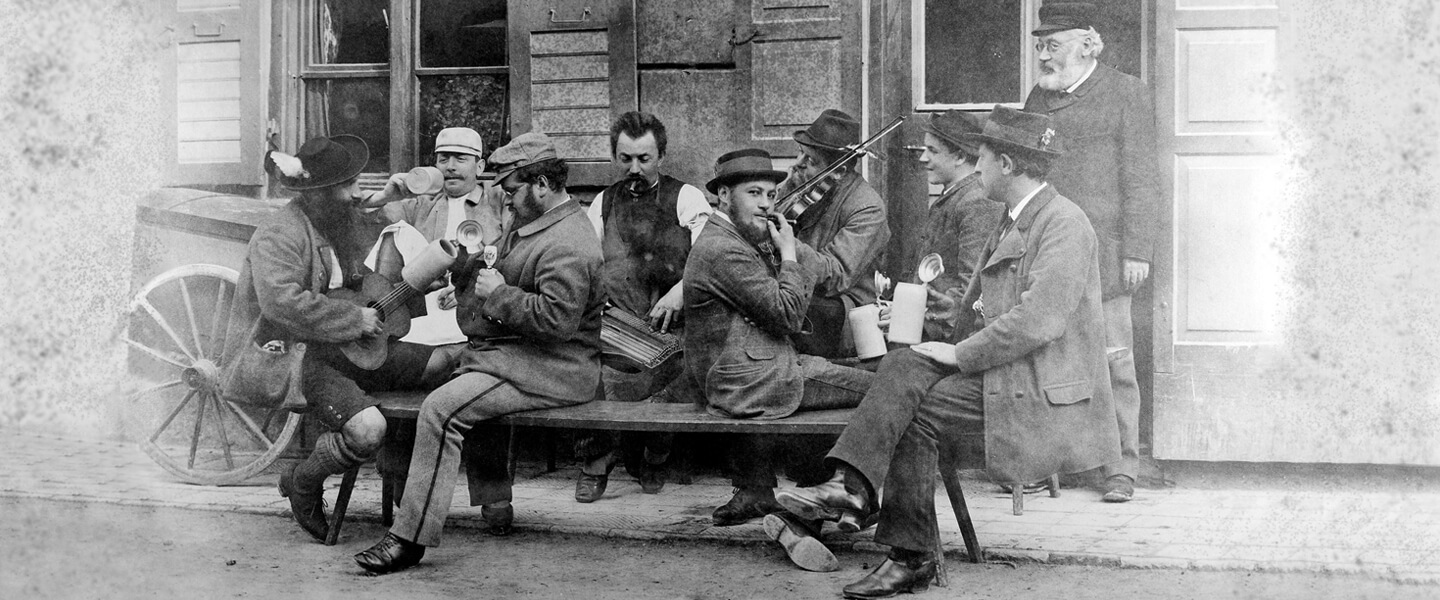
It was August 2nd, 1808, when Mr. Johann Jochner, merchant and Mr. Thomas Knilling, post expeditor and inn-keeper in Mittenwald, received the authentically right to brew beer by highest decree.
The war at that time – the Bavarians and French made war on the Tyroleans – stopped the immediate construction of a brewery. Not till 1820 Thomas Knilling's son-in-law, Mr. Anton Reindl, could finish the building, which is the rear part of the "Hotel Post" today.
In order to brew beer in summer they built so called "Märzen"- or "Sommerkeller" (summer cellars) into the mountain "Kofelhängen" (1835), today vis à vis of the clay wood sawmill “Kreuzer” and at the food of the mountain "Burgberg" (1840). Today the building is situated at the "Innsbruckerstrasse" no. 40. In winter large blocks of ice were cut out of the frozen lakes "Lautersee" and "Schmalensee" and stored in the cellars. Thanks to this method the brewing season could be prolonged until the ice was melted in summer.
Rosa, wife of the ancient brewery-owner Anton Reindl, survived her husband and their children and transferred all her possession to the son of her brother-in-law, Mr. Johann Baptist Neuner (+ 1903). Since January 9th, 1864, the brewery is family-owned.
September 30th, 1891 a conflagration destroyed the brewery building. For a while they evacuated the beer-production into the "Burgberg"-cellar, nowadays still called "Old Brewery". In 1892 the owners started the construction of new beer cellars outside of the village on a more than 20.000 square metres large area located at the Innsbrucker street followed by a new brewery building in 1898. The complete building-material as well as the machines and the equipment was transported from Partenkirchen to Mittenwald by horse-carts. It was April 8th, 1903, when the brewery was inaugurated with the first brewing.
To ensure the water supply the brewery renewed the wooden tubes existing since 1830 and built a cast-iron pipe from a place called "Stell" at the lake "Lautersee" to the new brewery building in 1898. Considering the pipe length of 1.750 m, the difference in altitude of 110 m, and the pipe relaying through the difficult terrain of the "Lain"-Valley looking similar as a gorge, is was a technical brilliant performance at that time. Besides of the supply with brewing and normal water they also used a six HP turbine to power the brewing machines by transmission and at night, feeding the batteries for the power supply by a generating unit. From 1946 to 1950 they changed the power supply from direct-current to purchased rotary current.
Up to 1900 the above mentioned natural cellars were sufficient for cooling the beer. In the new brewery building they constructed an additional ice cellar with a capacity of 1.200 cubic metres. In 1935 the cooling process changed from natural ice to a Linde ammonia compressor with diesel-engine, and since 1964 two foreign current compressors run with a capacity of 10.000 respectively 30.000 kcal.
Up to 1921 heat requirement was supplied by wood heating only, then additionally with coal from Upper Bavaria. In 1965 the whole power requirement was served by light fuel, since 1992 by natural gas due to ecological reasons.
To save energy the large cold storage room equipped with drip cooler was replaced by a plate cooler which now supplies the whole warm water requirement of the brewery by waste heat recovery.
Since the early beginnings raw materials of highest quality grown in the region were used for the beer production. Until the shutdown of the own malt-house in the year 1963 the barley came out of the Munich area. Only superior hops from the "Hallertau" are used for the production and the malt is bought from trading malt-houses in Upper Bavaria.
The non-alcoholic beverage production started in 1929. Respecting the actual trend besides of the classic soft drinks the bottling of table water in kegs and bottles started in 2007.
By taking-over of the former wine-cellar J. Karg in 1960 the range of products was extended by wine, spirits and champagne. Nowadays they concentrate on wines from Southern Tyrol; since 1985 the brewery supplies their specialities to the "Bozener Markt", the famous market week which bans thousands of visitors in the rhythm of five years.
Two brewery-owned beverage markets in Mittenwald and Krün supply a high quality full product range in environmentally friendly deposit-bottles in the Isar valley.
Until 1934 the beer was transported by horse- and ox-carts. The last brewery horse left the brewery stable in 1965. The first lorry, a Hansa-Lloyd, started up in 1935. Now the brewery owns a modern motor pool supplying the restaurants and the private households by home service. The numerous alpine huts in the mountains of Karwendel, Zugspitze and Wetterstein are supplied by suitable vehicles.
To meet with the increasing demands the drum filling was changed from aluminium drums to stainless-steel kegs in 1981. A modern filtration plant and four stainless-steel pressure tanks (150 hl), built by the Gresser-company, followed in 1994.
For same reasons the bottling plant from 1964 had to be replaced in 2005 by a stock of engines corresponding to demands of nowadays. The construction work in the old building (first brick building of Mittenwald) was enormous and therefore they decided to install a new CIP-installation for fully automatic cleaning of pipes. In addition the brewery installed a CO-2-tank (6,000 kg) as well as a low pressure boiler (Viessmann 460 KW / 700 kg/h) meeting the new machine capacity.
This last structural alteration was completed by the installation of a new premix plant for soft drinks enabling also to fill bottles with screw-caps.
Brewery-owned pubs had always been a solid basis for the beer sale. Nowadays the Mittenwald Brewery invites to its restaurants "Stern", "Gries" and "Postkeller" as well as the bistro "Kutsche" and the "Wolpertinger Museum".
In 1977 the sales area expanded to Austria and a separate company for Austria was established.
Over the years the beers of the Mittenwald Brewery were improved and refined. New beer specialities were created, the "well-proven" adapted to the actual taste by correspondent brewing techniques. Besides of the owners the following master brewers were in charge for the production:
Mr. Gamsmeier 1916 – 1923
Mr. Fellner 1925 – 1931
Mr. Egger 1931 – 1937
Mr. Graf 1937 – 1942
Mr. Deubler 1942 – 1972
Mr. Hartl 1972 – 2004
Currently, our master brewer named Ulrich Pommer is responsible for the beer production.
In 1986 a little collection of old machines, devices and pictures was opened to show the history of the brewery to interested visitors.

|